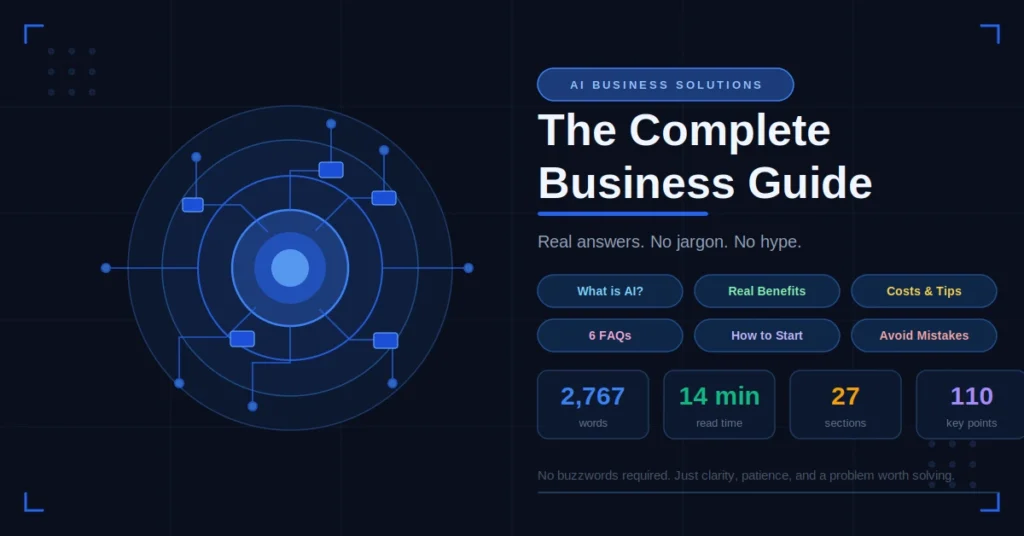
Let’s be honest — if you’ve been in any kind of business meeting in the last two years, someone has already said the words “we should look into AI.” Maybe it was your CEO. Maybe it was that one team member who reads too many newsletters. Maybe it was you, late on a Tuesday night, scrolling through headlines and wondering if your competitors are already ahead of you.
The frustrating thing? They’re probably right that you should look into it. But the conversation usually stops there, because nobody really wants to admit they don’t fully understand what “AI business solutions” actually means — or whether it’s something they genuinely need, or just another tech trend to survive and forget about in three years.
So let’s cut through it. No jargon. No hype. No pretending this stuff is simpler than it is. Just a real, grounded look at what AI business solutions are, what they can do for you, and what to actually think about before you go down that road.
What Are AI Business Solutions?
The Simple Definition
At the most basic level, an AI business solution is any tool, system, or process that uses artificial intelligence to help a business work better. That could mean saving time, cutting costs, making smarter decisions, or improving the experience for your customers.
But here’s where people get tripped up: AI isn’t one single thing. It’s a whole family of technologies — machine learning, natural language processing, computer vision, predictive analytics — and each one does something different. When a business talks about “AI solutions,” they could mean any of the following:
- A chatbot answering customer questions at 2 a.m. so your team doesn’t have to
- Software that predicts which products will run out of stock before it happens
- A tool that reads legal contracts and flags risky clauses automatically
- An algorithm that decides which leads your sales team should call first
- A system that detects fraudulent transactions in real time
The common thread is this: these tools learn from data, recognize patterns, and take actions or make suggestions that would otherwise require a human to sit down and think through. That’s what makes them valuable. And that’s also what makes them a little intimidating if you’ve never worked with them before.
AI vs. Automation — What’s the Difference?
This question comes up a lot and it’s a good one.
Regular automation follows rules you set. If a customer submits a form, send them a confirmation email. If an invoice hits a certain amount, flag it for approval. It does exactly what you tell it to do, every time, no more and no less.
AI goes a step further. Instead of following fixed rules, it learns from experience and data. It can handle situations that weren’t specifically programmed. It can improve over time. It can make predictions, not just execute instructions.
Think of automation as a very reliable worker who follows a checklist perfectly. Think of AI as a worker who studies patterns, learns from mistakes, and starts making judgment calls — within limits you set.
Most modern business AI solutions actually combine both. They use AI for the complex, variable parts and automation for the repetitive, predictable parts. Together, they’re more powerful than either one alone.
Where Businesses Are Using AI Right Now
Customer Service and Support
This is probably the most visible place AI shows up in business. AI-powered chatbots and virtual assistants handle the first wave of customer inquiries — FAQs, order tracking, appointment scheduling, basic troubleshooting. They don’t replace human support agents, but they absorb the repetitive volume so your team can focus on conversations that actually need a real person.
The best implementations aren’t the ones that try to hide the bot — they’re the ones that deploy AI where it genuinely helps and hand off to humans the moment it doesn’t. That handoff, done well, actually improves the customer experience rather than frustrating it.
Sales and Marketing
AI tools can analyze your customer data and tell you which leads are most likely to convert, what time to send a campaign email, or which product to recommend to which customer segment. This kind of targeting used to require a data analyst and several weeks of work. Now it happens automatically, in the background, while your team focuses on actually talking to customers.
Content creation, ad optimization, email personalization, lead scoring — all of it is being touched by AI in marketing departments right now. The businesses using it well aren’t replacing their marketers. They’re making their marketers faster and more effective.
Finance and Operations
AI is earning its keep in back-office functions too. It can flag unusual transactions that might indicate fraud, automate invoice processing, forecast cash flow, and spot inefficiencies in supply chains before they become expensive problems.
For operations-heavy businesses — manufacturing, logistics, retail — AI-driven demand forecasting and inventory management alone can deliver significant cost savings. The margins in those industries are tight enough that even a small improvement in predictive accuracy can make a real difference to the bottom line.
Human Resources and Hiring
HR teams are using AI to screen resumes at scale, reduce hiring bias, and predict which employees might be considering leaving — giving managers a chance to have real conversations before someone hands in their notice.
That last one is worth pausing on. Used responsibly and transparently, these tools can help companies be more proactive about culture and retention. Used carelessly, they can feel intrusive. The ethics matter here.
Everyday Productivity Tools
Then there’s the catch-all category that most employees are already bumping into: AI writing assistants, meeting summarizers, scheduling tools, code helpers. These aren’t enterprise implementations — they’re individual productivity boosters that are quietly adding hours back to people’s weeks.
If your team hasn’t started experimenting with these tools yet, they probably will soon. Better to have a policy and a conversation about it than to pretend it isn’t happening.
The Real Benefits of AI Business Solutions
Saving Time on Things That Shouldn’t Need Humans
The most immediate benefit most businesses feel when they adopt AI is that their people stop spending hours on tasks that don’t require human judgment. Data entry, report generation, scheduling, first-draft writing, status updates — AI handles it, and your team does higher-value work.
This isn’t about eliminating jobs. It’s about eliminating the parts of jobs that no one actually finds meaningful, and letting people spend more time on the things they were actually hired to do.
Making Better, Faster Decisions
Not because AI is smarter than your leadership team, but because it can process far more information faster and without emotional bias. A retailer using predictive analytics to manage inventory isn’t guessing what to stock — they’re making data-backed calls that reduce waste and avoid the lost sales that come with empty shelves.
The same logic applies to pricing decisions, hiring decisions, marketing budget allocation, and risk assessment. More data, processed more consistently, leads to better outcomes over time.
Improving the Customer Experience
Faster responses, more personalized recommendations, fewer errors, and 24/7 availability all add up. In competitive markets, the experience you deliver is often the difference between a customer who stays and one who quietly moves to a competitor.
AI won’t fix a fundamentally broken product or a toxic culture. But it can meaningfully improve the experience you deliver to customers at scale — and in a way that’s very hard to match without it.
Reducing Costs Over Time
This one takes longer to see, but it’s real. Automating repetitive processes reduces labor costs for low-skill tasks. Reducing human error in finance, compliance, and quality control avoids expensive mistakes. Better forecasting reduces waste. These savings compound.
The businesses that see the strongest ROI from AI aren’t the ones that implemented the flashiest tools. They’re the ones that were patient, picked the right problems to solve, and measured the results honestly.
What Nobody Warns You About
Your Data Needs to Be in Order First
Garbage in, garbage out. It’s a cliché because it’s absolutely true. If your customer data is fragmented across a dozen spreadsheets, if your processes are undocumented, if your teams work in silos — an AI tool is going to reflect all of that back at you, just faster and at greater scale.
Before you invest in an AI solution, ask yourself honestly: Do we have the data to support this? Is it clean, organized, and accessible? If the answer is no, fixing that comes first. It’s less exciting than buying new software, but it’s more important.
Implementation Always Takes Longer Than You Think
Whether you’re adopting an off-the-shelf AI tool or building something custom, the integration, staff training, testing, and change management usually take two to three times longer than the initial estimate. That’s not a reason to avoid it — just a reason to plan realistically and communicate honestly with your team about the timeline.
Your Team Has to Actually Trust It
This is underrated. If the people who are supposed to use the AI solution don’t understand how it works or don’t trust its outputs, they’ll work around it. They’ll do the task manually anyway, “just to double-check.” The tool becomes shelfware.
Adoption requires education, not just installation. People need to understand what the AI is doing, why it’s recommending what it’s recommending, and what to do when it gets something wrong. That conversation has to happen before launch, not after.
The Ethical Questions Are Real
AI systems can perpetuate bias if they’re trained on biased historical data. They can make decisions in ways that are difficult to explain or audit. Depending on your industry, there may be regulatory requirements around how you use AI — particularly in areas like hiring, lending, healthcare, or financial services.
These aren’t reasons to avoid AI. But they are reasons to ask hard questions of your vendors, audit your results regularly, and be willing to override the system when something doesn’t look right.
How to Know If Your Business Is Ready
Ask These Questions Before You Spend Anything
What specific problem are you trying to solve? The businesses that get the most out of AI start with a painful, concrete problem — not a vague desire to “leverage AI.” Slow response times? Admin overload on your sales team? Inventory costing you money? Start there.
Do you have the data to support it? Most AI tools need historical data to learn from. If you haven’t been collecting structured data, your options are more limited — though starter solutions exist even for early-stage businesses.
Who is going to own this? AI tools don’t run themselves. Someone needs to manage performance, handle exceptions, and update the system as your business changes. That might be internal or external, but it has to be someone.
What’s your realistic budget and timeline? There’s a wide range — from free AI features built into tools you already use, to six-figure custom builds. You don’t have to spend a lot to start, but you need to be realistic about what different investments actually get you.
Frequently Asked Questions About AI Business Solutions
Is AI Only for Large Enterprises?
Absolutely not — and this might be the biggest misconception holding small businesses back. Many of the most impactful AI tools available today are designed specifically for small and mid-sized businesses, and they’re priced accordingly.
Your CRM probably already has AI-powered lead scoring. Your email marketing platform likely has AI-optimized send times. Your accounting software may already flag unusual transactions. AI isn’t reserved for companies with data science departments. It’s becoming a standard feature across the tools that businesses of all sizes already use.
How Much Does It Cost to Implement an AI ?
The honest answer is: it depends enormously on what you’re trying to do.
At the low end, you might activate AI features already built into tools you pay for — effectively free. AI-powered customer service chatbots can be set up for a few hundred dollars a month. More sophisticated solutions — custom-built AI models, enterprise integrations — can run into the tens or hundreds of thousands.
The key is not to let the high-end numbers scare you away from starting small. Most businesses that eventually implement sophisticated AI started by testing cheap, off-the-shelf solutions on a single problem. Start there.
Will AI Replace My Employees?
Some roles will change. Some tasks that people currently do will be automated. That’s true and worth being honest about.
But the full picture is more nuanced. AI is much better at handling specific, repetitive, data-driven tasks than at handling the judgment calls, relationship-building, creative problem-solving, and context-reading that most jobs require. Most businesses using AI well are using it to change what their employees do, not to eliminate them.
The more useful question isn’t “will AI replace my team?” It’s “how do I help my team work alongside AI so we can do more with the same people?”
How Long Does It Take to See Results?
For simple implementations, you might see results within weeks. For more complex solutions that require data integration, custom development, and change management, it typically takes six to twelve months before you’re seeing the full picture.
Set realistic expectations upfront. Define what success looks like before you start, so you have something concrete to measure against. And resist the pressure to declare it a failure (or a triumph) too early.
What’s the Biggest Mistake Businesses Make with AI?
Trying to do too much at once. Businesses that attempt to transform multiple functions simultaneously, without a strong foundation of clean data and organizational buy-in, usually end up with expensive tools that nobody uses.
The businesses that win with AI pick one problem, solve it well, learn from it, and expand. That’s it. That’s the strategy.
Do I Need a Tech Team to Use AI?
Not always — and increasingly, the answer is no. Many modern AI solutions are designed to be used by non-technical teams. Chatbot builders, marketing AI tools, AI writing assistants, and analytics platforms are all built for business users, not developers.
That said, more complex or custom solutions — especially ones that need to integrate with your existing systems or are built on proprietary data — will require technical resources. Whether that’s an internal hire, a systems integrator, or the vendor’s own implementation team depends on the complexity of what you’re building.
Where to Start Without Overwhelming Yourself
Step 1: Identify One Problem Worth Solving
Don’t start with the technology. Start with the pain. What’s the one thing in your business right now that costs the most time, money, or customer goodwill? That’s where you start.
Step 2: Look at What You Already Have
Before buying anything new, look at the tools you already use. There’s a good chance your CRM, email platform, accounting software, or project management tool already has AI features you haven’t switched on. Start there. It’s low risk and often low cost.
Step 3: Test Small Before Scaling
Pick a pilot. One team. One process. One customer segment. Test an AI tool there, measure the results honestly, learn from it, and then decide whether to expand. This approach reduces risk and builds the internal knowledge you’ll need to scale effectively.
Step 4: Invest in Your People, Not Just the Technology
The most successful AI implementations pair the technology with genuine investment in helping people understand and use it. Training, clear communication about why you’re doing this, and honest conversations about how roles might change — all of that matters as much as which tool you choose.
Step 5: Measure, Adjust, and Repeat
Define what success looks like before you start. Measure it after. Adjust based on what you learn. AI isn’t a set-it-and-forget-it solution. The businesses getting lasting results treat it as a capability to continuously build, not a project to complete.
The Bottom Line
AI business solutions aren’t magic, and they’re not science fiction. They’re practical tools that, used thoughtfully, can make your business faster, smarter, and more responsive to what your customers actually need.
The businesses winning with AI right now aren’t necessarily the biggest or the best-funded. They’re the ones that were honest about their problems, thoughtful about their choices, realistic about implementation, and willing to learn as they went.
That’s a bar most businesses can clear — if they’re willing to approach it with the same common sense they’d bring to any other major business decision.
No buzzwords required. Just clarity, patience, and a problem worth solving.