Introduction
An infection of the tooth that is serious can be frightening, painful and, in very rare instances, deadly if left untreated. A frequent inquiry that people look up online is what is the time frame before an infection in your tooth kills you?
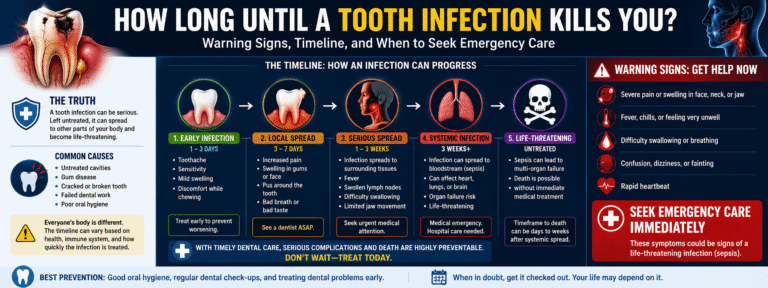
The truth is that there’s no set timeline. Untreated infections can remain localized for months or even weeks, while others may spread more quickly to tissues around the sinuses, the jaw and perhaps even into the bloodstream. When an infection starts spreading over the teeth, the possibility of developing serious complications is significantly increased.
The good news is that the modern dental treatments and antibiotics if needed, and prompt professional attention result in fatalities being extremely rare within the United States and other countries that have access to dental care.
How long until a tooth infection kills you? Learn the warning signs, infection timeline, serious complications, and when to seek emergency dental care
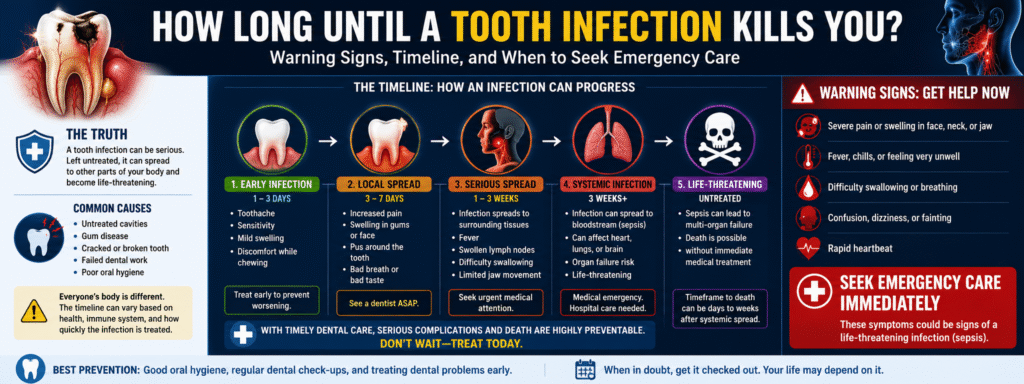
What Is a Tooth Infection?
A tooth infection, also known as the dental abscess is when bacteria get into the inside part of the tooth or the gum tissue around it. It could be due to:
- Untreated cavities
- Cracked teeth
- Gum disease
- Dental trauma
- Dental work that is not working
- Severe tooth decay
When bacteria infiltrate the deeper tissues, pus may build up and cause pressure within the gums or inside the tooth.
Most people experience minor symptoms, however the condition can become more severe in the event of a delay in treatment.
How Long Until a Tooth Infection Kills You? Warning Signs & Timeline
How long until a tooth infection kills you? Learn the warning signs, infection timeline, serious complications, and when to seek emergency dental carePostBlock
Paragraph
Start with the basic building block of all narrative.
Color
Text
Background
Typography
Font size
Size
Advanced
Skip to the selected blockOpen publish panel
How Long Until a Tooth Infection Kills You? Warning Signs & Timeline
How long until a tooth infection kills you? Learn the warning signs, infection timeline, serious complications, and when to seek emergency dental carePostBlock
Paragraph
Start with the basic building block of all narrative.
Color
Text
Background
Typography
Font size
Size
Advanced
Skip to the selected blockOpen publish panel
Can a Tooth Infection Be Fatal?
Yes, but it’s not common.
A tooth infection can be dangersome when bacteria are spread beyond the tooth to other organs of the body. The most serious complications could include:
- Deep facial inflammation
- Jaw infection
- Airway obstruction
- Infections in the bloodstream (sepsis)
- Brain disease
- Heart problems in the most vulnerable people
These conditions need medical attention urgently.
The risk is greatest in those who are unable to recognize symptoms for a long time or suffer from weak immune systems.
How Long Until a Tooth Infection Becomes Dangerous?
There is no precise number of weeks, days or months that apply to all people.
The rate of progression is based on various the factors that determine it, such as:
| Factor | Effect on Progression |
| Infections are spread through the body. | Certain regions allow for the spread of information to be faster. |
| Immune system health | A strong immune system can slow the development |
| Age | Older adults could be at risk of higher risk |
| Current medical conditions | The immune system and diabetes may make things worse |
| Access to treatment | Early intervention dramatically lowers risk |
Certain infections are localized for a long time, and others may spread in days.
Because the timing of treatment is uncertain As the timeline can be unpredictable, dentists advise seeking treatment as soon as signs begin to manifest.
Early Signs of a Tooth Infection
Early detection of symptoms can help prevent complications.
Common signs are:
- Teethache that persists
- Sensitivity to cold and hot food items
- A swelling around the gum
- A bad taste to the tongue
- Bad breath
- It is painful when chewing
- Gums that are red or swollen
At this point treatment can be easier and more efficient.
When a Tooth Infection Becomes an Emergency
Certain signs suggest that the infection could be expanding.
Seek urgent medical care if you experience:
- Rapid facial swelling
- Breathing difficulties
- Trouble swallowing
- A fever that is that is above 100.4degF (38degC)
- A swelling under the jaw
- Fatigue severe
- Confusion
- Heart rate rapid
The symptoms must be assessed immediately since they could be a sign of the presence of a serious infection.
Infection Progression Timeline
The following timeline serves as an example of a general nature. Actual progress can vary greatly.
| Stage | Typical Symptoms |
| Early Infection | Sensitivity to mild tooth pain and sensitiveness |
| Localized Abscess | Throbbing pain, swelling, pus |
| Spreading Infection | Fever, facial swelling |
| Severe Infection | A difficulty breathing or swallowing |
| Medical Emergency | Deep tissue inflammation |
There are many infections that do not follow this route however, it is a reason why it is crucial to treat the problem promptly.
Why You Should Never Wait for the Pain to Go Away
A common misconception is that a decrease in pain indicates that the infection has lessened.
In some cases, abscesses rupture it, releasing pressure and decreasing discomfort. However, the underlying problem could be still active and expanding.
A reduction in pain doesn’t necessarily suggest that the issue is solved.
Conclusion
If you’re thinking when the tooth infection is fatal the most precise answer is that there’s no set timeline. Although fatalities are not uncommon, an infection that is not treated could be dangerous in the event that it extends beyond the tooth.
The most secure method is easy to treat dental abscesses as soon as you can. The earlier treatment can prevent the risk of complications, reduces pain faster and safeguards general health.
An infection in your tooth isn’t something you should ignore. If you are experiencing extreme discomfort, swelling or fever, trouble swallowing or breathing difficulties take care to seek medical attention immediately.